
131. Arguing Well: How to Turn Conflict into Connection
Are you tired of constantly arguing about the same topics with your partner?
Do you feel like every disagreement pushes you further and further apart from one another?
Or have you realized that, in the end, the way you go into conflict isn’t the best one: either you shut down in silence, or you explode, and you don’t know how to communicate a point of view without falling into one of those extremes?
Then this podcast episode is for you.
In this episode I’ll share the advice of Dr. Julie Schwartz Gottman and Dr. John Gottman of the Gottman Institute. They’re therapists and researchers who have studied romantic relationships extensively to prove what actually works. Their research even involved asking couples to argue on camera, and by analyzing those videos they were able to observe which mechanisms were constructive in conflict and which were more destructive.
I personally loved this book and highly recommend that you buy it—it’s currently only available in English: “Fight Right: How Successful Couples Turn Conflict into Connection?” I assume it will be available in French soon. It’s a great book because the authors explain many real-life examples of couples to help readers fully grasp the concepts, so I highly recommend it.
From a personal perspective, this book confirmed a deep conviction I had—namely, that there are essentially two things that are essential for building a happy relationship:
- The first quality is appreciation—they use the term “positivity,” meaning the ability to see the positive in your partner and in the relationship. I really like the term “re-cognition” (seeing anew), which I explain in Episode 102: The Couple’s Magic Wand.
- The second skill is the ability to argue. The word “argument” might sound shocking, but ultimately, what is a conflict? It’s a situation where there are two different opinions, and for a conflict to be constructive, it requires the ability to understand the other person’s perspective and, during the discussion, to express your own viewpoint as clearly as possible in order to ultimately find win-win solutions. For me, this skill is the most essential because it prevents issues from being swept under the rug, that is, all those little conflicts that remain unresolved and add to the resentment in the relationship and that eventually lead to a disconnect. Whereas when you feel heard and understood by your partner—and you understand them in return—that connection naturally returns: you naturally want to spend time with the other person, you naturally want to do little thoughtful things for them, you naturally feel more desire for them—that’s ultimately the source of it all. The opposite isn’t necessarily true if you spend quality time with the person and are interested in them, but there’s still that “dust under the rug”—it’s kind of like a pseudo-connection to me: something is happening, but there isn’t really a strong bond there, and that’s why it’s essential to learn how to argue. That’s actually why I created the program Cultivating Love and I dare say and assert that I believe every couple needs to learn this to maintain their connection.
For you
FREE Webinar "HOW TO FREE OURSELVES FROM THE PATTERNS THAT PREVENT US FROM BEING HAPPY IN LOVE?"
Subscribe now to my newsletter and receive the replay of the webinar how a wound from the past is created ?
* Mandatory fields
If you register for this webinar, you will be subscribed to my newsletter and you will be able to receive offers from me. You can unsubscribe at any time. Please read my
privacy policy (german only), to see how I process the data.
What the Research Says
In their book, they mention 4 findings from their research that show you how important it is to learn how to argue well:
- The first finding is that they can predict with 90% accuracy which couples will stay together and be happy in their relationship — not just stay together for the sake of staying together, but truly be happy and fulfilled in their relationship (they call this type of couple the masters of love, the Masters of Love), and they describe the qualities these people share, namely:
- the ability to listen
- the ability to go into conflict rather than avoid it
- the ability to go into conflict in a constructive way
- the ability to make repairs if they’ve acted wrongly
- The second finding (which raises the stakes) is that the first three minutes of a conflict can predict the fate of your relationship six years later!
- The third finding is that they identified four sabotaging behaviors in conflict, which they called the four horsemen of the apocalypse, predicting the couple’s separation within 5 years:
- criticism
- contempt, meaning having negative thoughts about the other person as a person, which brings with it a sense of superiority over the other
- shutting down into silence
- being defensive
- The fourth finding is that 69% of conflicts are unsolvable, meaning there’s no easy solution, so this also calls for a skill I call ping-pong: being able to go back and forth, refining what matters most to each partner through the discussion, until reaching a solution that isn’t a compromise but a win-win solution. So for the singles listening, this doesn’t mean you should stay in an unsatisfying relationship where most of your relational needs aren’t being met. What this number means is that even if you meet someone things go well with, you’ll still have 69% of conflicts that are unsolvable. That doesn’t take away your responsibility to choose someone compatible with you who has the right skills to build a healthy relationship, because that can actually reduce this number.
The Three Main Conflict-Entry Styles Don't Influence the Outcome of the Conflict
They describe three ways of entering conflict, so three conflict styles:
- The avoidant style, which avoids conflict to preserve harmony and is fine agreeing to disagree.
- The validating style, which goes into conflict, is open to finding a compromise, and acts in a collaborative way.
- The volatile style, which tends to jump into conflict quickly, where tension can rise more easily — things heat up.
The Secret to Constructive Conflict Is the 5:1 Ratio
That is, 5 positive interactions versus one negative interaction during the conflict (they also measured the ratio outside of the conflict and estimated it at 20:1)
So how can you add positivity to your conflicts?
- Through nonverbal cues—it could be a smile, a nod, or a reassuring touch. Here, I’ll add a caveat: not all nonverbal gestures are positive for everyone. For example, something that often happens is when there’s a conflict and some people are very averse to touch because they feel threatened—this is often a reaction of your nervous system being in the sympathetic (fight mode), so even the slightest touch can feel like an attack. For someone else, smiling during a conversation might come across as insincere or dishonest, so be sure to observe what is considered positive by your partner to achieve that 5:1 effect.
- Take responsibility for your impact by saying, for example, “I recognize that my words were hurtful,” “I’m sorry for doing that,” “I think I was wrong about that,” ‘You’re right; I should have handled that differently.’ Sincerity matters.
- Validate the other person: for example, “I understand your point of view better now,” “Oh, yes, that’s a good point,” “You’re right,” “Thank you for opening up to me.”
- Talk about the positive aspects of the relationship: for example, reminding each other of everything you’ve already managed to overcome in the past, the things you have in common, your shared strengths, what you’re doing well in the relationship in general or in this specific conflict—everything positive about your relationship.
- Do you feel heard?
- Does your partner feel heard?
- Do you feel like you’re constantly in a battle during this discussion or are there little moments of calm, relief, reconnection, or lightness—even if the situation isn’t pleasant?
- A past wound of one partner is triggered by the situation, and their nervous system has taken over. This partner needs to self-regulate through their body. I talk about this in l‘ Episode 122: How to Regulate Your Emotions?.If you feel like this happens to you very often, it’s worth doing some in-depth work on your relationship patterns and the past wounds that get triggered in your relationships—that’s what I offer in my program Cultivating Love If you’d like to learn more, you can watch my webinar “How to Break Free from Patterns That Prevent You from Being Happy in Love?”
For you
FREE Webinar "HOW TO FREE OURSELVES FROM THE PATTERNS THAT PREVENT US FROM BEING HAPPY IN LOVE?"
Subscribe now to my newsletter and receive the replay of the webinar how a wound from the past is created ?
* Mandatory fields
If you register for this webinar, you will be subscribed to my newsletter and you will be able to receive offers from me. You can unsubscribe at any time. Please read my
privacy policy (german only), to see how I process the data.
- Either it’s because you’ve let too much dust build up on the rug, and every time you get into a conflict, the leftover issues resurface—which is why it’s so important to isolate and break down the sources of conflict. In their book, Julie and John Gottman discuss “kitchen sinking”—that is, starting one conflict and ending up in another—and it’s certainly difficult to resolve things afterward because you end up going in circles.
5 Tips for a Healthy, Constructive Conflict
The purpose of a conflict isn’t to find a solution, but to understand each person’s reality.It’s not just Gottman who says this—the founders of the IMAGO method say it too. It’s truly the basic principle for moving past a conflict.
In addition to this essential principle, they offer five key tips in their book for arguing in a healthy way:
- Start the conflict off on the right foot. Instead of criticizing, use “I” statements; describe the situation as factually as possible; and express your needs in a positive way by saying what you want rather than what you don’t want; I’d like to give a quick shout-out to the program participant Opening Yourself Up to Love—who I think will recognize many of the practical exercises they did during the program—and also listening to and validating the other person without being defensive but rather to understand their perspective and reality. Your perspective and your partner’s can coexist; neither is more justified or correct than the other.
2. Stay collaborative. He suggests three ways to do this:
- Take a break if you’re too emotionally aroused (sympathetic nervous system). For this, I recommend the “anger points” exercise, the “pushing the wall” exercise, or Esther Perel’s exercise—which I found very funny—to bring positivity into conflicts: lie down on the floor, because when you’re lying down, you can’t be in attack mode
- You set a maximum timeframe for getting back to each otherthey recommend no later than 24 hours; in the IMAGO method, they recommend setting a specific time to meet, which I think is a good idea because it allows both people to be available and open to discussion.
- Make amends if you weren’t able to stay calm.
3. Pursue your dream. Julie and John explain in their book that recurring, persistent, and intractable conflicts are often a sign that there is a more or less conscious difference in each partner’s dreams, and they suggest discussing this by listening to and validating what the other person says, in accordance with the principles of IMAGO dialogue, which I explained in Episode 72. To foster the dialogue, they suggest 6 questions to help your partner identify the dream hidden beneath this conflict:
- Why is your position in this conflict important to you?
- What value, conviction, or belief does your stance in the conflict reflect?
- What would be the ideal situation—your dream?
- Is this stance connected to an experience from your past or childhood?
- Is there an underlying goal?
4. Identify areas of flexibility. The idea isn’t to compromise—which is more of a win-lose dynamic—but to identify each of your essential, non-negotiable needs and find a win-win solution. This requires more back-and-forth, but it’s really worth it so you don’t end up feeling like you’ve sacrificed yourself for your relationship in the long run. They recommend the bagel approach—so the bagel is a sandwich where in the middle is what’s non-negotiable, like your ham or cheese, and on top or bottom are the layers that are more flexible and negotiable. So, for example, if I draw the parallel with the sandwich again, if it’s not really that important to you to have a sandwich with lettuce or tomatoes, you can leave that part out while keeping the core—namely, your ham or cheese. You get the idea.
5. The last point is to resolve past conflicts in other words, to clean up that proverbial dust swept under the rug and, basically, to make amends—that is, to have a conversation where you listen to the other person, take your share of responsibility, and also communicate how you’d like to handle things next time—so a formal commitment to change your 50%, and of course your partner goes through the same process as well.
So here’s this episode on conflicts—I hope you enjoyed it and that it inspired you to learn this skill, which is essential for relationships. And if you feel like you’re not getting anywhere or that the conflict you’re facing is just too big, my advice is: don’t wait until there’s too much swept under the rug. I read somewhere—I can’t remember where—that couples generally wait 5 to 6 years before seeing a therapist or a relationship coach, so my advice to you is that there’s no harm in asking for help before it’s too late—that is, before the disconnect becomes too great—to avoid reaching that point of no return.
That’s why I explain all these tools in my program for singles Opening Up to Love because I believe that the sooner you learn this, the more it helps you build a solid relationship.
Going further
Si tu as envie d’approfondir le sujet et de comprendre pourquoi vos discussions tournent en rond, tu as mon livre Les couples heureux…osent aborder les sujets qui fâchent disponible dans toutes les librairies.
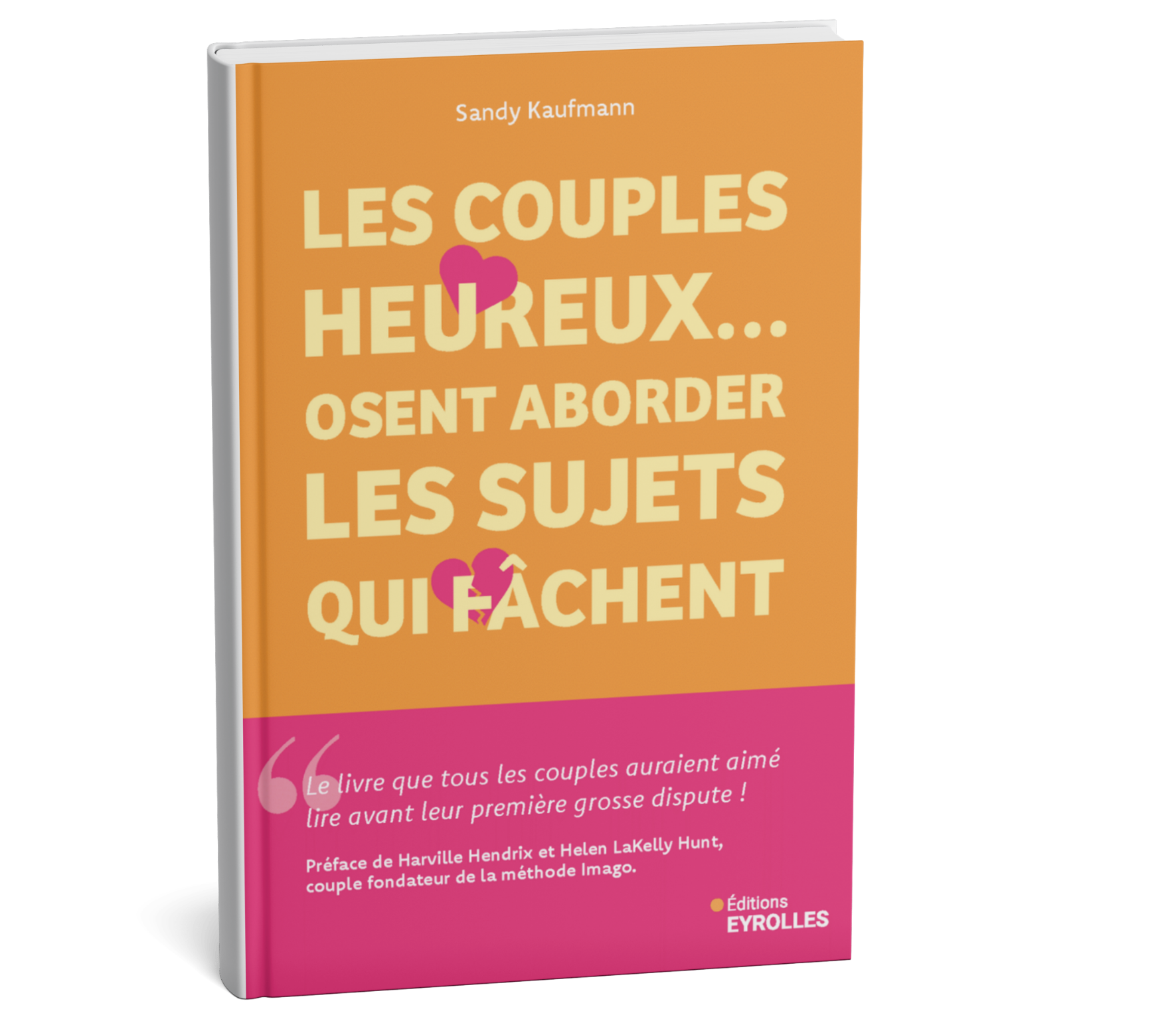
Contrairement aux idées reçues, les couples qui durent ne sont pas ceux qui évitent les conflits mais qui savent les traverser. Le livre Les couples heureux..osent aborder les sujets qui fâchent t'explique comment transformer vos tensions en connexion en 5 étapes!
Going further
 CULTIVATING LOVE — if you’re in a relationship
A 5-month program to transform your relationship, rediscover connection, communication, and the joy of being together every day.
It includes modules you can complete at your own pace—as a couple or on your own—the option to receive confidential coaching via email, the option to add individual coaching sessions, as well as the Day of the Past option to reset relationship patterns through the body if you feel that your inner child is playing a major role in your conflicts.
Sandy Kaufmann
is a somatic therapist and coach, based in Switzerland. She is the author of two books published by Éditions Eyrolles and has accompanied more than 600 people. She is the creator of the Somatic Deprogramming method and hosts the podcast “S’ouvrir à l’amour”, ranked in the French top 50 in the relationships category.
Table des matières


