
The secret of couples who last
The secret of couples who last
What makes some couples last, with partners who stay close and keep thriving together? Is there a secret that makes these couples last? The answer to this question is not so obvious, because in my opinion, after 8 years of practice, every couple builds its own secret that makes things work well between them. More in episode 71 of S’ouvrir à l’amour.The secret of couples who last
What makes some couples last, with partners who stay close and keep thriving together? Is there a secret that makes these couples last? The answer to this question is not so obvious, because in my opinion every couple builds its own secret that makes things work well between them. And it even changes over the course of their relationship.(see this article if you want to know more about the stages of a relationship.) Even I, after 9 years in a relationship and as a love coach, do not have this certainty at 100%, because it is a balance that, in my view, is constantly being redefined as each partner and the couple evolve. Imagine how much you have changed in 10 years of life. That will not change when you get into a relationship. Instead of a miracle recipe valid for everyone, there are, in my view, 3 aspects to consider to help each couple find its secret:- Understand the physiological evolution of romantic feelings after several years of living together
- Be clear about the role of the couple and the expectations toward it
- Cultivate the ingredients needed for a successful life as a pair
❤️ Watch my webinar on how to finally be happy in love!
Understanding how romantic feelings evolve after several years together
This part follows the article on how a man falls in love where I summarize Dawn Maslar’s research on the physiological mechanisms that take place when we fall in love and how different they are between a man and a woman.
In this same research Dawn Maslar finds that after falling in love, hormones return roughly to their original level, that is, to the level before the meeting, and that couples who continue to stay together do so by conscious choice.
At this point in the relationship, it is no longer the reptilian brain that drives the relationship, but the rational brain, more specifically the cortex, the same area of the brain that connects us to our values, to our desire to be the best version of ourselves by developing qualities such as compassion and unconditional love. It is typically the area of the brain that is activated when you do personal development.
In other words love starts as a feeling and ends up being a choice.
It is therefore normal to see a change in the couple’s passion after several years together, because the hormones return to normal.
Dawn Maslar nevertheless describes two phenomena that occur in parallel with this change of brain:
- Using the prefrontal cortex will reduce our feeling of attraction toward other people.
- Mirror neurons allow us to benefit even more quickly from our partner’s experience, in the sense that we learn faster what they know how to do, because they have already acquired that skill and we are often in contact with them.
Being clear about the role of the couple
I hope the description of the physiological evolution of romantic feelings will give you a more realistic expectation of the role of the couple in your life.
For me the couple remains and will remain only one part of your life, in the sense that for me the couple is two independent individuals, fulfilled in their respective lives, who decide to share the bonus of the couple, that is, this cherry on the cake (sharing your life with someone you love) and not the whole cake.
And so that means two things: first, that your first mission is to keep thriving personally, independently of your couple life.
And second, that you can take advantage of this cherry on the cake, which is the couple, for your own personal development.
Once the couple commits for the long term, it becomes for me a personal development tool, in the sense that it is within the couple, in this zone of safety and love, that each partner’s wounds from the past will resurface. The couple becomes the unique opportunity to settle what was not resolved in the first home where we experienced this safety (or not), our parents.
Crises often occur when there is a change in the degree of dependence on the other partner at the structural level (for example with the arrival of children), at the financial level (for example when the spouse loses their job), at the emotional level (for example if one of the spouses loses a loved one), at the physical level (for example if one of the spouses falls ill).
And so staying together finally becomes a choice to go all the way with your personal development, because changing partners will not necessarily help you solve the problem, you will simply live the same problem with another person.
Of course up to a certain point. For some couples, separating will be the best solution.
In my program Cultivating Love I offer different tools for reflection to understand what is hiding behind a relationship crisis, that is, which wounds resurface for each partner, what the couple can do to soften and manage the conflict, how each partner can help the other in their process and which questions to consider to decide whether or not it is worth continuing.
The ingredients for a successful life as a pair
I hope that at this stage of the article you are clear that staying fulfilled in a relationship takes work.
Which means you must devote to it:
- Time, and above all quality time. Here quality prevails over quantity. How much time do you dedicate to your partner to spend a pleasant, quality moment and not only to divide up the tasks?
- Give your couple priority. When the couple is going through a bad patch, it is a natural reaction to keep busy otherwise, with other activities (outings, sports, seeing friends) to escape the crisis. But when you want to get through this crisis, you also have to invest time in it and sometimes reduce your investment in certain personal activities to dedicate more time to your couple.
- Nurture the relationship with gestures of attention and love.
- Accept that the other has a different pace of evolution from yours, which may mean that the crisis lasts longer and that you therefore have to find a way to “wait” until the other person does their part of personal development.
- Stay positive about the relationship
- Keep having projects together
- Consciously decide to admire your partner by focusing on what they do well. Not easy when you are in the middle of a crisis.
- Keep fulfilling yourself outside your relationship
At this level of the relationship, each partner becomes the expert of their couple, because you are best placed to understand what you need to thrive. I personally find it beautiful to see the couple become the greatest tool for personal development and a way of experiencing unconditional love.
Believe me, it is worth it.
For you
FREE Webinar "HOW TO FREE OURSELVES FROM THE PATTERNS THAT PREVENT US FROM BEING HAPPY IN LOVE?"
* Mandatory fields
If you register for this webinar, you will be subscribed to my newsletter and you will be able to receive offers from me. You can unsubscribe at any time. Please read my
privacy policy (german only), to see how I process the data.
Going further
Une première étape: mon livre
Si tu as envie d’approfondir le sujet et de comprendre comment construire une belle dynamique, tu as mon livre Les couples heureux…osent aborder les sujets qui fâchent disponible dans toutes les librairies.
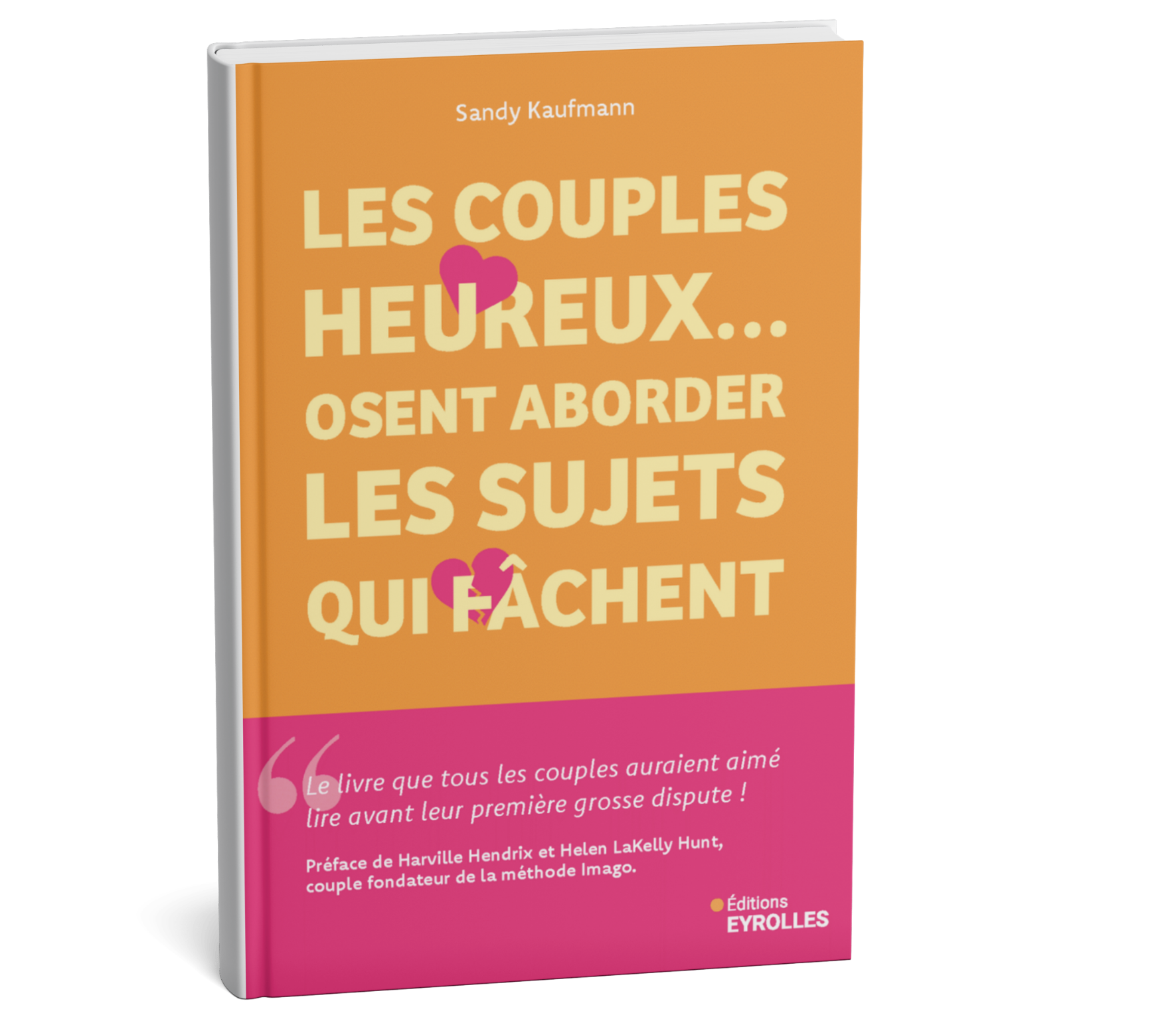
Contrairement aux idées reçues, les couples qui durent ne sont pas ceux qui évitent les conflits mais qui savent les traverser. Le livre Les couples heureux..osent aborder les sujets qui fâchent t'explique comment transformer vos tensions en connexion en 5 étapes!
Sandy Kaufmann
Table des matières


