
The 3 States of Your Nervous System and the Polyvagal Scale
This episode is part of a trio of episodes designed to introduce you to my approach to love coaching.
In episode 152, I explain why your nervous system impacts how you relate.
In episode 153, I described the 4 main categories of patterns based on my empirical observations of the people I’ve worked with.
In this episode, I will describe the 3 states of your nervous system and the polyvagal scale.
❤️ Watch my webinar on how to finally be happy in love!
The 3 States of Your Nervous System
Polyvagal theory, developed by Stephen Porges, explains that our autonomic nervous system constantly scans our interactions with the environment and others to ensure our survival. This scan occurs automatically, without the intervention of the rational brain, based on our perceptions of the environment, and can induce 3 distinct physiological states:
- The Ventral Vagal State In this state, you naturally seek social interactions, you are able to connect with others and feel connected. In this state, you feel supported by the group, you trust life and others, you feel free to be yourself. (This is the gentle brake). The frontal area of the brain is activated. Physiologically:
- You are relaxed, energetic, with a rather slow and regular heart rate. Blood pressure and digestion are optimal. Muscles are relaxed.
- Your breathing is slow, deep, and regular.
- Facial expression is flexible, adapted to interactions.
- You can inhibit background noise to focus on the frequency of the voices of people around you.
- Your own voice follows a melody (prosody) and you have a sound volume appropriate for verbal communication of your thoughts, feelings, and emotions.
- The Sympathetic State. In this state, you feel stress and you are alert to danger; social engagement is harder because you think more about how to react (fight or flight). Prefrontal cortex activity is reduced, with the brain prioritizing survival over rational thought. Physiologically:
- You are agitated, you have a surge of energy (“stress response”).
- Your heart rate and blood pressure increase, and blood is primarily directed to your legs and arms. Muscles are tense, ready to act.
- Your breathing is faster or shallower.
- Digestion is interrupted and salivation reduced. If this state becomes chronic, you may lose appetite or experience nausea.
- Your facial expression is rigid, inflexible. Your cheeks flush.
- You can no longer inhibit background noise, which becomes overwhelming, because your nervous system, in a state of hypervigilance, tunes into frequencies lower and higher than the human voice, in order to detect the presence of danger.
- Your voice is shrill, at too high a volume.
- The Dorsal Vagal State. Your body feels unable to act, without a solution (freeze/immobilization). In this state, you feel profound helplessness, a freezing or disconnection from the body, and you are so overwhelmed by stress that your body collapses: it plays “dead” in the face of the environment and others (this is an abrupt brake). The prefrontal cortex is largely inactive, severely hindering rational thought and communication. Physiologically:
- You can no longer communicate.
- Your energy is very low, you feel exhausted, and, in the long run, you will tend to suffer from chronic fatigue.
- Your breathing is slower, shallower, irregular.
- Your heart rate and blood pressure slow down, which can lead to discomfort.
- You lose control of your bladder and intestines.
- Your face is expressionless and pale.
- You no longer react to ambient noises, especially attempts to communicate with you.
- Your voice is monotone, at a very low volume.
What is a Regulated Nervous System?
In polyvagal theory, Stephen Porges distinguishes 3 states of the nervous system: the ventral vagal state, the sympathetic, and the dorsal vagal state.
A regulated autonomic nervous system can easily transition through the 3 states of the nervous system to cope with life’s stresses and then naturally return to the ventral vagal state (vagal brake). The ventral vagal state is not a permanent refuge; the idea is to return to it often enough for the body to regenerate and be able to face future stresses.
This survival mechanism is useful and healthy when there is real danger. Who would want to take the time to think about how best to act if a bear was charging at you?
So, having a regulated nervous system does not mean:
- Always being serene
- Never being activated
- Never being frozen
A regulated nervous system allows you to:
- Transition easily from one state to another
- Return to the state of safety, the ventral state, quickly
- Have a sufficiently large tolerance margin for what activates you to welcome life’s stresses
If you want to learn more about what might have dysregulated your nervous system, listen to episode 121 or watch my free webinar “How to free yourself from love patterns to finally be happy in love?”
For You
THE free WEBINAR
"How to free yourself from patterns that prevent us from being happy in love?"
Sign up for my newsletter now and receive the webinar replay.
For you
FREE Webinar "HOW TO FREE OURSELVES FROM THE PATTERNS THAT PREVENT US FROM BEING HAPPY IN LOVE?"
* Mandatory fields
If you register for this webinar, you will be subscribed to my newsletter and you will be able to receive offers from me. You can unsubscribe at any time. Please read my
privacy policy (german only), to see how I process the data.
The Polyvagal Scale
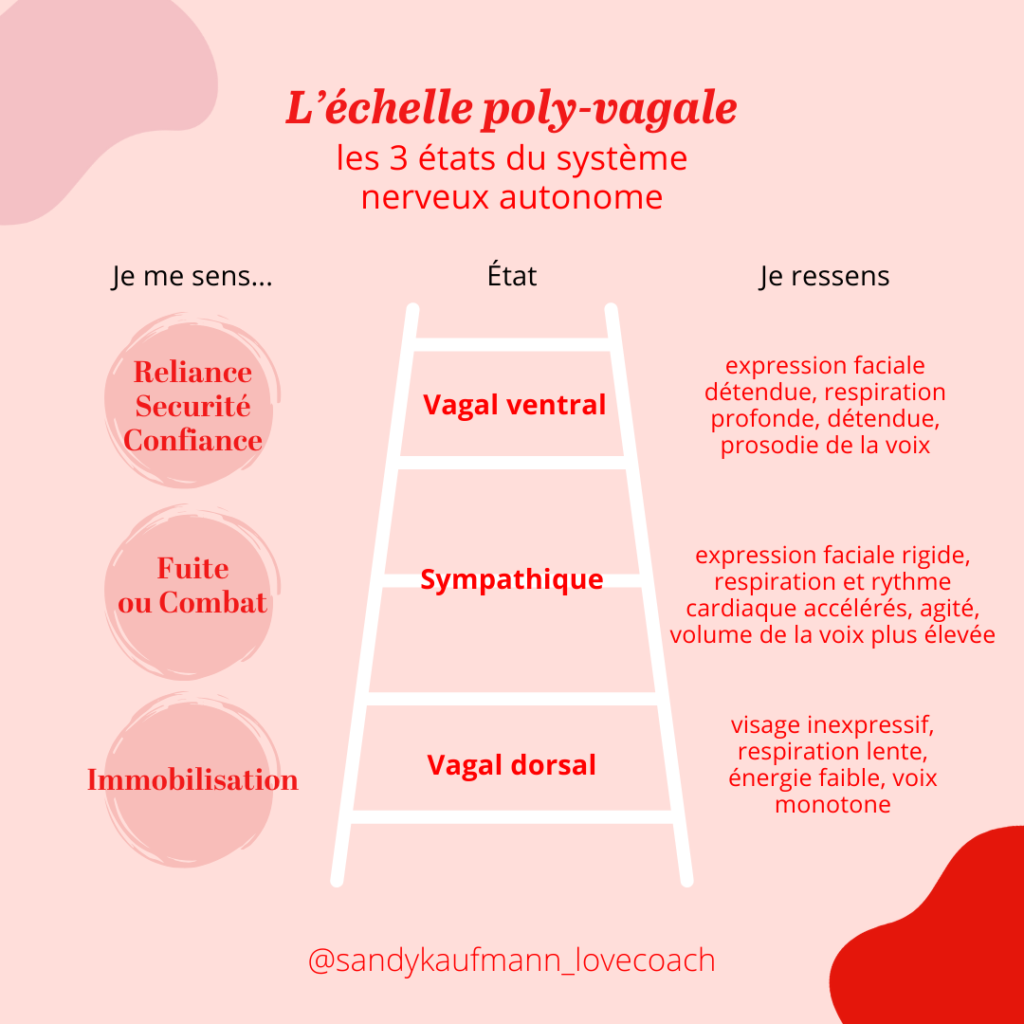
The scale is a predictable hierarchy: states can only be crossed in a specific order described in the polyvagal scale. For example, if you are immobilized, you cannot simply move to the safety state and social state, but must first pass through the sympathetic state, even if briefly.
For people with a dysregulated nervous system, the transition through this scale can be rapid and extreme: you go directly into a highly activated sympathetic state and then feel immobilized. Returning to the ventral state can then take longer.
Becoming Aware of Your States
Taking the time to connect with your bodily sensations to identify your state will have several beneficial effects:
- Learning to be present with your bodily sensations and emotions is what will allow you to recreate safety within yourself.
- Understanding how your state can influence your perception of what you are experiencing and choosing a more appropriate response for yourself.
- Regaining confidence in your nervous system’s ability to return to its state of safety and familiarizing yourself with pendulation, meaning the transition from a state of insecurity to a state of security.
- Providing yourself with what you need to return to safety. Because you know your state and it’s easier to choose what works best, and you also verify it by becoming aware of your bodily sensations.
To go further and start listing the resources that help you return to your ventral state, you can listen to episode 62 on the polyvagal roadmap.
Becoming Aware of Your Dominant State
Having a dominant state simply means you tend to be in that state more often than others. Even with a dominant state, you continue to change states regularly depending on what you are experiencing.
Based on observing your states, you will be able to determine the state you are predominantly in. You can also evaluate your dominant state based on your dominant attachment style. I discuss this in more detail in episode 89.
Why is it interesting for you to know your current state and your dominant state?
Knowing your dominant state will allow you to understand if your dominant perception will lean towards safety or insecurity.
Knowing your state during a certain situation will help you distinguish facts, understand how you are activated by that situation, and how you can support yourself in that situation to return to your state of safety to choose a more appropriate response.
To Go Further
If you want to delve deeper into the subject and identify your own love patterns, my book Opening Up to Love is available in all bookstores.

Opening Up to Love
The book that will help you identify your love patterns and teach you the keys to building a healthy relationship
To Go Further
Sandy Kaufmann
Table des matières


