
84. The emotional bank account
I can already hear you saying “but Sandy, do you really think keeping apothecary-style accounts in a relationship is a good thing ? Isn’t it better to give without expectation, as much as you want to give ? When you are a friend or a partner with someone, you should not count.”
To which I answer you : “How do you feel in a romantic relationship that only goes one way or when your girlfriend asks you for yet another favor without ever returning the favor to you ?” Annoyed, used perhaps, or you will drift away without realizing it consciously.
This concept of the emotional bank account I used for myself to assess how satisfied I was with my current relationships (my perception of whether the relationship had more of a positive or negative balance for me) and how to change them without only asking the other to give me what I wanted.
I learned 15 years later that this concept was taken up in Stephen Covey’s best seller The 7 Habits of Highly Effective People and that he gave a list of behaviors that bring “credit” to the relationship, a concept that was presented and expanded in episodes 153 and 154 of the podcast Change ma vie where Clotilde Dusoulier gives you an interesting reading grid to assess what you bring to the relationship and the biases that can skew the perception of what the other brings to the relationship.
In this episode I am going to share with you the angle from which I personally used this emotional bank account, the advantages of assessing your relationships from this angle, what comes as a debit or a credit to the bank account and how you can influence the balance of the emotional bank account. I will add a few tips from David Bradford and Carole Robin taken from their book Connect to develop extraordinary relationships.
What makes a relationship satisfying?
In my view, a harmonious relationship is a relationship in which “taking, giving and receiving” are perceived by the parties involved as balanced, in which there is mutual satisfaction. This highlights two important criteria for a balanced relationship :
- A need for balance “between taking, giving and receiving” which is not necessarily 50/50
- The perception of the parties involved
❤️ Watch my webinar on how to finally be happy in love!
Another important factor: the time factor
When it comes to a long relationship (long-standing friendships or couples), the time factor also comes into play.
If I go back to the example of this best friend who likes to do favors, she will be inclined to give more without expecting anything in return (in other words, to put herself in the “negative”) if her friend is going through a difficult phase, for example.
This also explains why some relationship crises last over time, because one partner always considers themselves in the “negative” compared to the other (this partner may not have received enough support from their partner in a difficult personal phase, or on the contrary may have given too much to help their partner in a difficult phase and did not get the recognition they wanted).
Stephen Covey’s definition says that a quality relationship is directly linked to the level of trust/security between the people who make up the relationship and that the relationship is fruitful, that is, that it brings more credits>debits. He also specifies that the right to make mistakes is possible, you simply need to consciously bring credits to the relationship.
David Bradford and Carole Robin in their book Connect say that an extraordinary relationship is defined by the following 6 characteristics :
- You can be fully yourself and the other person too
- You are both willing to be vulnerable
- You trust that your disclosures will not be used against you
- You can be honest with each other
- You handle conflicts productively
- You are both committed to the growth and development of the other.
If I try to sum up these 3 definitions, there are 4 major criteria that make a relationship satisfying
- The mutual satisfaction
- The perception assesses the relationship
- Investment /commitment/trust/security in the relationship
- Integrity/Honesty of each person
What are the advantages of seeing your relationships as an emotional bank account ?
- Understanding that a relationship is never a given and that it can break when debits become greater than credits
- Understanding that a relationship can be repaired. If you realize that you have debited a relationship a lot, you can correct it consciously.
- Giving yourself the right to make mistakes. What you do once in a relationship will not determine the whole relationship. It is all of your actions that count.
- Understanding the systemics of the relationship, how your actions indirectly influence those of the other (double debit), the quality of the relationship (negative or positive balance)
- That your perception of the balance of the relationship may be totally different from that of your partner, which is based on their own perception. Hence the importance of clarifying your expectations, the way you see the couple in the relationship.
- The impact of time in the relationship. The importance of the regularity of attentions and that the other perceives them as attentions. The longer the relationship lasts, the more the old balances will have an impact on the quality of the current relationship.
How did I personally use this emotional bank account ?
- First I assessed the balance of each of my key relationships : do I perceive this relationship as satisfying or not ? If so why and if not why ? What would have to change for me for it to be satisfying ? I was able to observe the following 4 tendencies :
A. You give too much, you credit the relationship too much. In my romantic relationships, I tended to project myself very early, to very quickly do a lot and therefore to very quickly bring a lot of credits to the relationship. You can also add credits by forgetting yourself for the relationship/the other (you stop working for the children, you move for the other). No problem with being generous you will tell me. If you look at this from the angle of the emotional bank account, by doing this you “force” the other to go into emotional debt when the person may not yet want to commit or give at that level. The perverse effect of this behavior is that it can push the other to end the relationship rather than try to “rebalance” this unwanted balance.
B. One of the partners debits the relationship and apologizes every time. You perceive what the other does as unsatisfying, the other acknowledges it and apologizes but keeps repeating the same behavior, for example the person does not keep their commitments to you, their way of speaking. The emotional bank account allows you to understand that this type of behavior brings nothing to the relationship and can lead to an increasingly negative balance if the other draws no lesson and continues their behavior.
C. You give badly. Depending on the intention with which you give or not in the relationship, or if you lack consistency, or if what you give is not perceived as positive by the other partner, the credit brought to the relationship will be smaller and this allows you to understand the person’s distancing.
D. You take from the relationship and give little. If you feel the other is moving away/disconnecting or that you receive a lot of reproaches in a relationship, a first assessment you can make is to see whether you have the same perception as the other of what you “give” in the relationship versus what she gives, by asking for feedback.
2. For the key relationships that I perceived as unsatisfying, since your satisfaction is based on your perception and not necessarily on the other’s actions, I asked myself how I could restore this balance by myself ? If I go back to the 4 tendencies from earlier you can apply it this way :
A. You give too much, you credit the relationship too much. In this case you can learn to manage your expectations/the thoughts you have about the relationship and your projections, and to give less or invest in reciprocity in the relationship. If you think the other gives you badly, how can you communicate more clearly what you need ?
B. One of the partners debits the relationship and apologizes every time. You can ask yourself whether you can accept this behavior and have a satisfying relationship without trying to change the other, and if not, communicate clearly that the apology has no value for you in this case. If the other does not understand you can try doing the same on another action they do not like and apologize each time to create a mirror effect.
C. You give badly. You can check your alignment :
-If you think you give badly, do you give to buy the other’s love or because you want to give, your commitment : is your behavior the same over time or at the beginning of the relationship do you do more/give more than you want in order to please ?
-If you do not know, do you ask the other for feedback ?
D. You take from the relationship and give little If you are aware that there is a relational debt in some of your relationships you can limit the people who do too much, by taking less (refusing their help) or by giving more (recognition for example) to balance the relational debt in the relationship and prevent it from breaking.
3. Assess the impact of the time factor. Perhaps the current relationship is balanced but the history of the relationship is unbalanced/indebted
A. For example if you went through a difficult phase, this person was there for you, you can decide to restore the balance by consciously bringing credit to the relationship either by acknowledging what the person did for you or otherwise.
B. If you realize that you put your life on hold for the couple (quitting a job, moving…) to clear the debt the other partner would have to realize their relational “debt” and make an extra effort compared to the usual “dose” of attention. However sometimes they did not necessarily ask for this indebtedness. One way to rebalance this is for the partner “in the negative” to consciously ask for “repayment” of their debt.
When you start making this assessment, you may ask yourself these questions:
- “But maybe I am asking too much? /I have too many expectations” The answer is simple. If you really have this need, then you must respect it, you do not create needs for yourself to annoy others. What you can first ask yourself is whether you have a way of fulfilling this need yourself without depending on the other for this need.
- “The other may perceive the relationship totally differently ”. Yes and it is by communicating and questioning your reciprocal perceptions that you can find common ground because in the end what we ask for in a relationship are only preferences.
What contributes to the credit of a relationship according to Stephen Covey
- Trying to understand the other. (Taking an interest in the other’s interest in proportion to the importance of the other to us)
- Taking care of the little things
- Keeping your promises and commitments (being trustworthy)
- Clarifying expectations
- Staying honest in the relationship (inside and outside we are the same person)
- Apologizing sincerely if we have made a debit
The relational qualities that contribute to an extraordinary relationship according to Davis Bradford and Carole Robin :
- Vulnerability
- Empathy
- Mutual satisfaction
- The degree of influence in the relationship. There are several ways of giving up influence in a relationship :
- assuming your needs are secondary to those of others
- not listening to your feelings
- letting yourself be interrupted
- backing down when someone disagrees with you
- avoiding conflict
- not giving feedback, assuming the problem comes from you
- worrying about being loved/approved of and considering this the most important thing
- downplaying the importance of your comments
- not taking credit for your achievements
- not pointing out a problem if you do not have a solution.
- The feedback
- The management of conflicts
And if I keep going into debt ?
Once you have done this assessment for all your relationships, it also allows you to see in yourself whether you have a relational tendency (e.g. always giving too much) that repeats and whether there is a deeper rebalancing work to be done, which requires looking into your past for what generated this unbalanced relational mechanism and correcting this automatism.
This is what we do in Opening up to love if you are single or Cultivating love if you are in a engaged relationship
For you
FREE Webinar "HOW TO FREE OURSELVES FROM THE PATTERNS THAT PREVENT US FROM BEING HAPPY IN LOVE?"
Subscribe now to my newsletter and receive the replay of the webinar how a wound from the past is created ?
* Mandatory fields
If you register for this webinar, you will be subscribed to my newsletter and you will be able to receive offers from me. You can unsubscribe at any time. Please read my
privacy policy (german only), to see how I process the data.
Pour aller plus loin
Si tu as envie d’approfondir le sujet et de comprendre pourquoi vos discussions tournent en rond, tu as mon livre Les couples heureux…osent aborder les sujets qui fâchent disponible dans toutes les librairies.
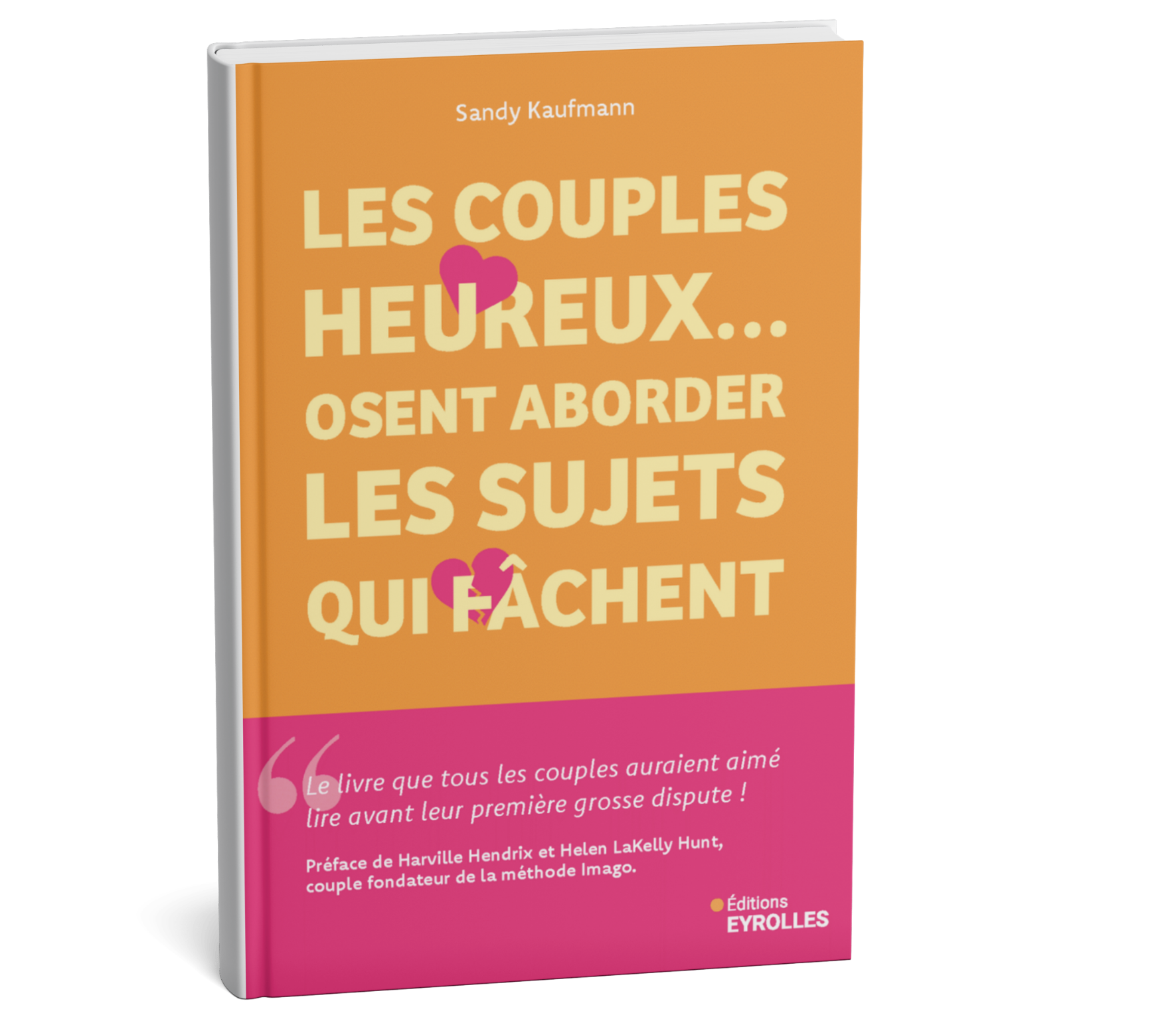
Contrairement aux idées reçues, les couples qui durent ne sont pas ceux qui évitent les conflits mais qui savent les traverser. Le livre Les couples heureux..osent aborder les sujets qui fâchent t'explique comment transformer vos tensions en connexion en 5 étapes!
Going further
🌿 CULTIVATING LOVE — if you are in a relationship
A 5-month program to transform your relationship, regain closeness, communication and the joy of being together every day.
It includes modules to do at your own pace as a duo or solo, the possibility of being coached by email in complete confidentiality, the possibility of adding individual coaching sessions as well as the Day of the Past option to deprogram love patterns through the body if you feel that your wounded inner children take up a lot of space in your conflicts
Sandy Kaufmann
is a somatic therapist and coach, based in Switzerland. She is the author of two books published by Éditions Eyrolles and has accompanied more than 600 people. She is the creator of the Somatic Deprogramming method and hosts the podcast “S’ouvrir à l’amour“, ranked in the French top 50 in the relationships category.
Table des matières


