
47. The 3 steps to get past a couple’s crisis
What is meant by a couple’s crisis?
I did not find a unanimous definition so I offer you mine. For me a couple’s crisis is a period of intensified conflicts with a recurrence of the theme. What is at stake in the crisis is the potential separation of the couple. It is not a small isolated quarrel or minor disagreements that are part of everyday life.
A couple’s crisis does not happen by chance.
It happens when life experiences awaken certain wounds from the past and reinforce interdependence on the other partner:
- Dependence on freedom/time with the arrival of a child
- Financial dependence work stoppage of one partner/entrepreneurship, financial difficulty, reduced working hours (mom stays at home)
- Physical dependence with illness, depression, burnout
- Emotional dependence grief over a person
A couple’s crisis is inevitable and it is a sign that the couple has enough intimacy, that the partners feel connected and safe enough to “let” the crisis emerge.
Once the couple commits for the long term, it is within the couple, in this zone of safety and love, that the past wounds of each partner will resurface. The couple becomes the unique opportunity to settle what was not resolved in the first home where we experienced this safety (or not), our parents.
And in this fragile phase, love is not enough. In my second book Les couples heureux osent aborder les sujets qui fâchent, I give you an analysis grid that allows you to identify what is at play in your crisis.
❤️ Watch my webinar on how to finally be happy in love!
The good news is that it can be learned.
It takes the right tools to understand what is awakened by this crisis, calm the conflicts and calmly begin the deeper discussions.
It is normal during this crisis phase to want to leave your partner, to have phases where you no longer believe in it. The less good news is that what you do not manage to settle with your current partner you will find exactly the same problem with the next one. This does not mean that you must not separate from your current partner (you are only responsible for your 50%) but that it is worth working on your 50% for your own romantic happiness whether with him or the next one.
I really like the expression of Florentine d’Aulnois-Wang “the couple stings” because it stings exactly where it should, that is in your last defenses and your deepest relational insecurities, to bring them back to the surface and offer the space to heal them within your couple (an episode soon on this subject of the couple’s space).
Step 1: Identify the past wounds underlying the crisis
Take stock to understand which wounds are awakened by the crisis. Here are a few avenues for reflection:
Describe the crisis in your own words, what you argue about, what you do not agree on.
Describe the actions or reactions of your partner that made you feel negative emotions
What would the ideal situation be (what should he say or do)? What would you think of yourself and of him if he did that?
With whom did you not get this in your past ?
- Deprogram your past wounds with the psycho-corporal approach (more info in episode 3) and empty out the emotional overload with the belly massage to start afresh
Step 2: Calm the crisis
- Understand and change your conflict dynamic. Here are a few examples of dynamics:
- Leaving the room and the other follows
- One does not want to talk and the other wants to settle it right away
- One wants to talk about it with friends, the other feels hurt by that.
- Put communication tools into practice to understand each other better
- Nonviolent communication
- Take full emotional responsibility (you can listen to episode 12 on this subject). If you always focus on what the other does not do you feel powerless in the face of the situation and you do not move things forward.
- See what works well and remind yourself of it. Not everything is wrong
Step 3: Get past the crisis
- Cultivate love
- Give each partner the time to work on their wounds
- Begin the deeper discussions and put into practice the tools to get out of the crisis
Imago Relationship Therapy, developed in the 1980s by Harville Hendrix Ph.D., founder with his wife Helen LaKelly Hunt Ph., offers a way of talking that allows each partner to feel fully heard by the other. This is the IMAGO dialogue, which works as follows:
- Promise of safety and commitment.
- Both partners are willing to talk. Set an appointment.
- The first partner explains their point of view for a given time (5 min to 30 min) and the other reflects back until the other feels 100% understood. At the end the other must sincerely try to understand the other’s point of view.
- The second partner does the same.
These work steps I offer in my group or individual coaching. If you are in a couple’s crisis, you can do this work as a duo or solo with my program Cultivating Love. Because when you change, the other is obliged to adapt to your change.
For you
FREE Webinar "HOW TO FREE OURSELVES FROM THE PATTERNS THAT PREVENT US FROM BEING HAPPY IN LOVE?"
Subscribe now to my newsletter and receive the replay of the webinar how a wound from the past is created ?
* Mandatory fields
If you register for this webinar, you will be subscribed to my newsletter and you will be able to receive offers from me. You can unsubscribe at any time. Please read my
privacy policy (german only), to see how I process the data.
Pour aller plus loin
Si tu as envie d’approfondir le sujet et de comprendre pourquoi vos discussions tournent en rond, tu as mon livre Les couples heureux…osent aborder les sujets qui fâchent disponible dans toutes les librairies.
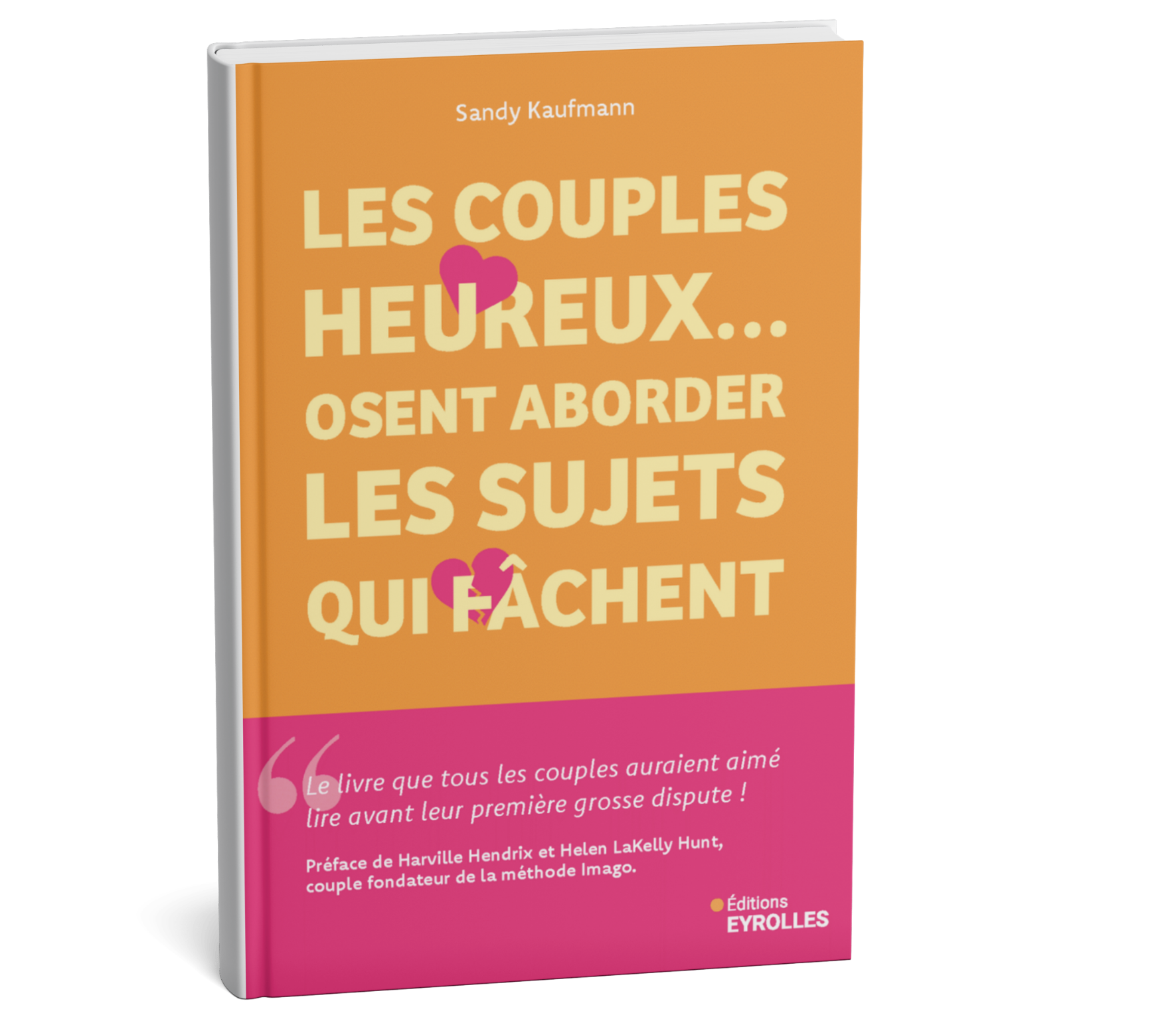
Contrairement aux idées reçues, les couples qui durent ne sont pas ceux qui évitent les conflits mais qui savent les traverser. Le livre Les couples heureux..osent aborder les sujets qui fâchent t'explique comment transformer vos tensions en connexion en 5 étapes!
Going further
🌿 CULTIVATING LOVE — if you are in a relationship
A 5-month program to transform your relationship, regain closeness, communication and the joy of being together every day.
It includes modules to do at your own pace as a duo or solo, the possibility of being coached by email in complete confidentiality, the possibility of adding individual coaching sessions as well as the Day of the Past option to deprogram love patterns through the body if you feel that your wounded inner children take up a lot of space in your conflicts
Sandy Kaufmann
is a somatic therapist and coach, based in Switzerland. She is the author of two books published by Éditions Eyrolles and has accompanied more than 600 people. She is the creator of the Somatic Deprogramming method and hosts the podcast “S’ouvrir à l’amour“, ranked in the French top 50 in the relationships category.
Table des matières


